Showing posts with label authors. Show all posts

Monday, March 9, 2020

A strange deep dive into Fletcher Hanks and more


One thing led to another and I found myself hunting for what I consider Hanks' weirdest image.
Oh, in finding the one I wanted, the bottom one with Leopard Women on Giant Saurians, I also found the above from another of his comics. That one reminded me a lot of Piers Anthony's Tangle Trees so I had to include it as well.
The Hanks comics came from You Shall Die By Your Own Evil, a biography of Fletcher Hanks. The man turns out to have been a bit of a monster himself. But he sure could imagine stuff!

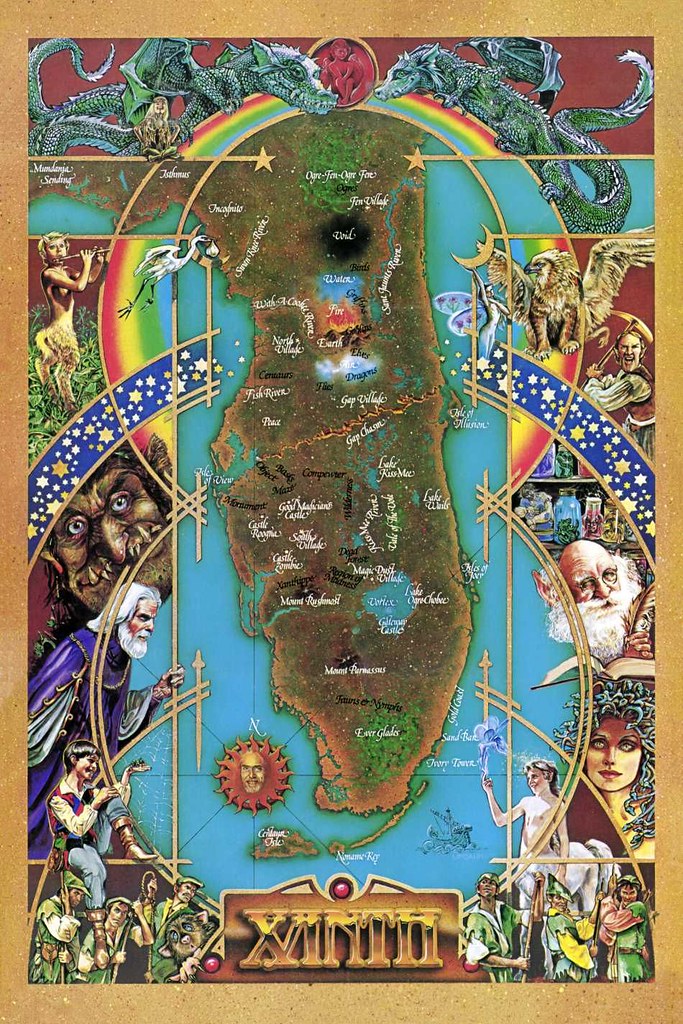
As I wrote, I found myself looking at a version of a Tangle Tree, so I found this discussion of Beer Barrel trees on Anthony's Xanth. And learned that Xanth looks curiously like Anthony's state of Florida:


Going down a rabbit hole like this almost feels like I accomplished something today!

Friday, February 7, 2020

Thinking about writing and rereading

In my last two Nanowrimo books, I wrote a lot of setting looking for a coherent story. In 2019, there was a character who needed to escape her world, spend time in ours and then return to her own, accidentally bringing someone from our world with her. Why was she in our world? I wasn't sure and hoped a good reason would appear and fit in while I wrote. So I had prepared in my mind that she

  • was or had a magical device to keep safe from others,
  • was hunting for a magic device on our world,
  • was a princess or other Chose One being kept safe.

The thing is, I hadn't picked one and so was vague about motivations and other details, instead mostly writing about travel and setting.

Fred Clark writes at his blog, Slacktivist. One thing he discusses is The World's Worst Books. This is not a constantly changing array of books, but one single series and he has been writing about them - or wrote about them - for decades. From the beginning of the blog post You can read this entire series, for free, via the convenient Left Behind Index. The ebook collection The Anti-Christ Handbook: Volume 1 seems to have disappeared from Amazon.
From midway through the post.
Redundant exposition and logistics we always get to read word-for-word. But when two characters have a conversation about their “hopes, fears and dreams,” all we are told is that this conversation took place. We know nothing more about their hopes, fears and dreams than we did at the start of the book.
Jenkins’ rule for dialogue seems to be that every logistical matter must be discussed aloud by his characters, but anything that might reveal who those characters are ought to be left unspoken and unwritten, only summarized in the most generic terms possible.

Clark is right about the books being terrible and this criticism is also correct. And it is exactly what I do! Runaway best seller, here I come!
More seriously, according Clark, Jenkins ran a class in novel writing that actually fits with Nanowrimo, where you were to complete a full novel and be ready to sell it in 28 days. At such a pace, you might need to skip motivations during the first draft and not have time to insert them later.

My current opinion on creativity is that it has a lot to do with bravery. Once Jenkins gives a character hopes, fears and dreams, he must remember them and refer to them as the character changes. In giving a character a few hopes and fears, or in my case, a reason for spending ten years on another world, the author is limiting other events and actions. Once limited, it is hard to broaden again. It takes bravery and some trust in yourself to add those limits and expect to see them through. I don't know if I have that bravery and Jenkins doesn't seem to.

While I am insulting people who actually publish their work, let me continue with that and write about rereading stories.

Do you reread books? A recent Twitter poll had a lot of respondents saying they did and what felt like an equal number saying there were too many books out there to go back and reread.

I reread a lot and discussed that with the example of the Riddle Master of Hed series. But this and some other events got me thinking about rereading a book, but not.

The first books I read included Roger Zelazny's Dilvish the Damned stories.  These were short stories that were collected into one volume and that is how I read them. But because they came from independent short stories, each chapter had quite similar expository sections where the character was named and described as well as the magic and weapons he carried. Reading each chapter was in a sense rereading some amount of the previous one.

This was pronounced in EC Tubb's series about Earl Dumarest of Terra, This was 100+ books long but also really the same book. I guess to save time and speed the story up, a lot of details were the same in each book. From using his fists like 'blunt axes' to woman cleaning his wounds and letting their fingers hang over the bandage to sneak caresses of his muscles to using 'slowtime' to move faster than others to every story having gamblers and priests - none of these are plot points but world building or background.

In modern times, I find every Jack Reacher book to be the same book with Reacher simply solving problems by punching them.

So is there a difference between reading a book ten times and reading ten Jack Reacher books or ten Earl Dumarest books?

To keep my post instructional, if only for me, let me note that I have described some very popular books today. The Jack Reacher books sell very well and there are currently two movies out with the character. It seems that even if Reacher or Dumarest stories are repetitive, people get comfortable with that repetition. We know these powerful, dangerous men will more than survive, they will thrive despite the dangers and they will beat the hell out of their opponents. Those opponents will suffer their evil!

Lessons noted, maybe not learned, today:

  • repetition sells. It sells well. And repeating yourself is a successful tactic.
  • Another successful tactic? Punching someone, especially with fists like blunt axes.
  • Oh, and take that risk, make that limiting decision, don't just wait for it to resolve itself.


Saturday, December 7, 2019

Riddle Master of Hed, and awful book covers


A discussion of the Riddle Master books at Tor caught my attention. I commented there and wanted to share it here:
I love Fantastic Beasts and the Riddle Master series. I have reread the latter books more than any others.
I do have some nitpicks – It drives me crazy to read, “Her face vague,” as a description of someone mysterious.
  • Kingfisher: “she…had vague gray eyes”
  • Forgotten beasts “His eyes were vague with struggling…”
  • “She stared vaguely…”
  • Riddle Master, regarding The Pig Woman, ” The vagueness dropped from her face like a mask, “
  • The Morgol of Herun, ” at the brief, vague touch of the gold eyes”
  • Morgon doing magic, ” for a moment his eyes were vague, “
  • etc
  • “…his eyes vague as though..”


During my third to maybe seventh rereads, I had trouble with Morgon’s tantrums. He would smash a bowl or something. For example,

“Morgon reached methodically for the sword Bere had been sketching by the fire, swung it in a wide, blazing half-circle, smashed it in a snap of blue sparks against the stone wall. It gave a deep, flawless, bell-like protest before he dropped it, and he said bitterly, hunched over his stinging hands, “You could answer my questions.””


Later, it bothered me how so many people loved Morgon and Deth and Yrth. Maybe I am slow but it took a few more reads for me to recall they were basically gods and perhaps people loved them because they had to, rather than from friendship or the like.


and yet, I love those books and the beautiful descriptions.


Anyway, I saw the books on sale at a used book store a week ago and they caused me to want to reread them again.

-


This series was part of what made me want to be a writer. I didn't have all those criticisms thirty five years ago. It was just a cool story with wonderful things happening. And then Morgon became so powerful and mysterious and I wanted to know more.


Still, those tantrums bother me. And how does someone have a vague face?


-


I learned about Good Show, Sir on the same day as reading on Tor about Riddle Master. They have one other connection.


Good Show, Sir is a blog that shares terrible SF/F book covers. And this is the Riddle Master cover I remember best:


I don't remember any such purple. Morgon seemed to dress modestly and though a prince, was a prince of a small land and so also did his own farming. Maybe I am looking for an excuse to reread it for the 20th (probably) time but I don't remember anyone dressed this way. (Image from)


It doesn't really match Good Show, Sir for weirdness, though. Here is the weirdest one I saw at GS,S:


Sunday, May 12, 2019

Silvermint on Pantsers and Plotters

The two terms are Nanowrimo lingo. Silvermint in the process of discussing Game of Thrones, explains them well on Twitter:
It has to do with the behind-the-scenes process of plotters vs. pantsers. If you’re not familiar with the distinction, plotters create a fairly detailed outline before they commit a single word to the page. 
Pantsers discover the story as they write it, often treating the first draft like one big elaborate outline. Neither approach is ‘right’ - it’s just a way to characterize the writing process. But the two approaches do tend to have different advantages. 
Because they have the whole story in mind, it’s usually easier for plotters to deliver tighter stories and stick the landing when it comes to endings, but their characters can sometimes feel stiff, like they’re just plot devices.

Pantsers have an easier time writing realistic characters, because they generate the plot by asking themselves what this fully-realized person would do or think next in the dramatic situation the writer has dropped them in.

But because pantsers are making it up as they go along (hence the name: they’re flying by the seat of their pants), they’re prone to meandering plots and can struggle to bring everything together in a satisfying conclusion. 
That’s why a lot of writers plot their stories but pants their characters, and use the second draft to reconcile conflicts between the two.

Those are among the first seven tweets in a thread of thirty.

Wednesday, April 10, 2019

TMIC: a grab-bag of goodies as an excuse for not posting recently

I like the spiders and so much more at Ketrina Draws a Lot.

This of course is a snipped image. To see the whole thing, follow the link.
--
I took an online course on creativity and we had to be in groups. I tried so hard to join the 'Creationists' team. That was the only time I tried to be a creationist. How many creationists are there in the US?
--
Curiosity should be boundless.
--
Writing is an expensive job.
-
Very slightly related: why a writer moved away from the big cities.
--
Pinker's 13 tips for writing.
--
The home that inspired Wuthering Heights.
--
I have been procrastinating a lot. I presume all wannabe writers say this. Here is a look at procrastination. I'll read it later.

Friday, February 22, 2019

An interview with Lev Grossman

I struggled through the first Magicians book but began to really love the series. the lead character, Quentin, is not likeable in the first book but becomes a hero by the end.

Here is a recent interview with Grossman.
It’s still hard sometimes keeping a connection to the fictional worlds I’m trying to nurse into being — life intrudes a lot. But there’s a true thing people say about writing, which is that some people can’t not do it. They can’t help it. So even when I’m walking around, doing errands, getting the car fixed, taking the cat to the vet and so on I’m thinking through stories and characters and sometimes just individual sentences, turning them over in my head. It never stops. I can’t turn it off.
This is similar to other writers' descriptions. They write because they very nearly have to. I wish I had that.

Tuesday, May 22, 2018

$20 words in Julian May's Nonborn King

I had an idea for a blog post; I would measure the difficulty of the vocabulary of a book I had just reread. I expected in the course of research to find that this book used a lot of difficult words. I appear to be wrong about that. If anyone is interested, there are two websites in the body of the post that can measure how many tough words you have used.

1983 edition of Book 3 of May's saga of Pliocene Exile, softcover.
Image result for nonborn king softcover
Image from Goodreads.
I first read this book around thirty years ago and saw it in a used book store recently so I reread it. I was greatly surprised that I didn't know the meanings to all the words - the text is pretty advanced.
I mean, I was able to puzzle enough of the meaning out that could follow, even enjoy, the story but two or three words stopped me in my flow of reading.
It made me wonder how difficult the text is. As an ESL educator, I am aware of a few websites that measure the difficulty of a text.

I used English Profile Text Inspector and started with an excerpt from a Jack Reacher story.

And then had to type an excerpt from the Nonborn King- I could find the text on Google Books but that only had images of the text, dang it! Anyway:

Dang! I figured the May text would have more difficult words than the Child text, but there are quite similar. I didn't think to check the black bar on the graph until after I did the Nonborn King. With it, I know that the software is part of the problem.
Ah, the software didn't double a few words, that is an artifact of how combined screenshots. Anyway, there are some simple contractions - "That's" for example, as well as names that are common (as opposed to common names). It may be that my measuring site is not up to the task.

Let me try another text inspector, this one actually having the name Text Inspector.

I can't say why I chose a Jack Reacher book by Lee Child for comparison purposes. Without any reason for the opinion, I had figured it would be a simpler text. And yet the two are quite similar. Huh. It may be that comparing excerpts of less than 250 words does not create a useful sample size.

Monday, May 21, 2018

TWIC:Design and interfaces, threats to sue, teaching, awards

User Interfaces on realtor websites. I am slow on such things. My main takeaway is that if we see a dollar sign, we won't need the words "Listing Price".  When there is a person's name and phone number, we don't need to be told, it is for the agent and how to contact them.

---
Writer discusses how he threatened to sue other publishers in his letter asking a publisher to handle his book:


---
2017 Nebula Awards winners
---
Podcasting as a writing exercise - for students.
---
design elements and writing
---
Legit publisher or not?  Not, and the link offers what to look for.
---


Monday, April 2, 2018

TWIC: procrastination, writing, music, desks, sewing, emotions and language

On fighting procrastination.
  1. The dream to have a great body, but never being motivated to go workout.
  2. The dream to succeed in college, but not having the willpower to study.
  3. The dream to be wealthy, but not having the discipline to build it.
  4. The dream to get married, but never being brave enough to commit.
  5. The dream to have a loving family, but never taking time off work.
Numbering is different in the original.
---
An interview with PC Hodgell (Youtube link but interview is exclusively audio).
---
Harsh truths from famous writers.
16. Get through a draft as quickly as possible. Hard to know the shape of the thing until you have a draft. Literally, when I wrote the last page of my first draft of Lincoln’s Melancholy I thought, Oh, shit, now I get the shape of this. But I had wasted years, literally years, writing and re-writing the first third to first half. The old writer’s rule applies: Have the courage to write badly. – Joshua Wolf Shenk
17. Substitute ‘damn’ every time you’re inclined to write ‘very;’ your editor will delete it and the writing will be just as it should be. – Mark Twain
---
Thousands of out of print sewing patterns.
---
Crib Sheet for journalists (ESL edition).
---
Tiny Desk Contest (maybe for hedgehogs but also for American musicians)
From the rules:
Videos must:
  • feature a desk (there must be a desk—any desk—in the Video);
  • contain a song that is the Entrant’s original work (covers will not be accepted);
  • be created specifically for the Contest (videos that were submitted to previous NPR Music Tiny Desk contests or to any other contest or competition will not be accepted);
  • be a maximum of ten (10) minutes in length;
  • be uploaded to YouTube in any format acceptable to YouTube; and
---
Maggie Stiefvater discusses College or Not?
Nowadays that means that my past novels are paying my mortgage while my current project is paying future bills. But back then, it meant I was happier having another job while I worked out getting published.

And, I mean, biologist sounds like a good job.
This has gotten very long and it’s all saying essentially the same thing: don’t let WRITER be your identity, even if WRITING is your ultimate job. Don’t conflate FOLLOW YOUR DREAMS with IGNORE COMMON SENSE. Don’t believe that somehow putting aside your writing to get a degree in Zebra Husbandry means you have abandoned your true self. Don’t think about a ticking clock, think only about forward movement. Pursue whatever degree will give you that balance of identity, security, and vivid creative material. Only you can answer which degree fills in that blank.
---
The subject for your next book. You use the letters of your name to fill in the blanks:
A/an A B about a/an C D E to F his/her/their G.
A Keenly Observed Trilogy about a Young Man's Quest to Understand his Sexless Marriage.
Seems quite the melodrama - and this subject would be somewhat easy to write in that I am shy about writing about sex.
---
Plutchik's wheel of emotions.

Image cropped. Follow the above link for the whole thing. Via eqjosh.
---
A young artist on Instagram commented elsewhere asking for comment on his/her artwork. I don't consider myself as having discriminatory taste in artwork but it seems pleasant.
---


Tuesday, October 3, 2017

TWIC: 1702 math text,Terrible Dahl, Money, logos

Rebecca Steel's accompt book.
Book description:
Scope/Content: "Anno 1702" is written on the title page, but within the text, the present year is given as 1701 and as 1702.
Scope/Content: Manuscript mathematical cipher book written in 1701 and 1702 by Rebecca Steele, a young student in Bristol. Pages exemplifying specific mathematical operations and concepts are embellished with calligraphic designs and command-of-hand drawings, and some lessons are dated. Many processes and operations are described in long word problems, including one (p. 30) where Steele is set the problem of figuring her exact age. She gives her birthdate as 28 May 1689 at 8:12pm and the present date as 17 April 1702 at "about 10 in ye morning." She is likely the Rebecka Steele who appears in Quaker birth records for the city of Bristol as a daughter of William and Melior Steele, born on 28 May 1689 in Thomas Street.
Condition: Bound in contemporary speckled calf with blind tooling and metal clasps.
Via pharyngula.
---
Maybe one reason I am not a published author is because I am a really good guy. Apparently, Roald Dahl was a bit of a monster and look how well he wrote.
---
How to make $290,000 selling books. Amazon has removed the book, priced as $290,000 from its website.
---
A Nanowrimo friend interviews author Kelly Morse.
---
Science Fiction and Fantasy: ruined by Atheism?
---
Logos drawn from memory. As always, this image was shrunk slightly and the the link has more details. Click to see it somewhat larger.
via Kottke.
---
I like the idea of text prompts to help me think of a short story. But incomplete doodles will work, too. Here are some interesting completions of a few doodles.

---
Control room eye-candy (images shrank, etc):


---
11th century herbal remedy guide digitized.


Boingboing has a summary.

Monday, July 24, 2017

TWIC: at camp, Microsoft Word, grit, balance, planning

I start my This Week In Creativity roundups the day after the previous one is posted. So I am writing this on Tuesday the eighteenth. Between now and the time this is posted I will start work at an ESL and science camp. I really can't say if this will be a shorter post than usual or not.
---
Encouraging grit and imagination in the classroom. This sounds like the perfect post for me. Actually the Sci-Am link starting this paragraph only describes the videos and idea.  The videos are at Imagination Institute and look to be a version of TED talks.
----
Using Microsoft Word to write a book? Among book snobs, the idea is nearly revolutionary. The industry standard is probably Scrivener or the like. But Tallulah Lucy defends Word.

My trilogy is currently sitting at 316,078 words, which amounts to 732 Microsoft Word pages. It’s all in a single doc.
I’m not saying that to impress anyone (it still needs to be edited down!). Only because a few people I’ve chatted to seem to think that you need some fancy writing software to write anything of that length. I actually find Word really easy to use, and it’s all because a few years ago I figured out how to structure a document for a novel.
Here’s what I do, and hopefully it can help you too.
1. Navigation Pane
Under “View” on the main menu, check “Navigation Pane”. This is the key to the entire thing. The Navigation Pane allows you to view the document by headings, pages or by search results. The headings is the important thing, as you will be able to navigate directly to each heading by clicking on it.
2. Scrap yard and Marker
The first thing I type is Scrap Yard, the second is Marker. Both of these should be on their own lines and set to Heading 1. You will find Heading 1 under Styles on the Home tab of the main menu. Then they show up in the Navigation Pane. You want to start typing your novel above this.
3. Using headings to structure the novel
Something that I know I vastly underestimated when I started writing was how much time I’d spend skipping back to check stuff. Whether it’s a character name, a piece of dialogue or what the hell happened in That One Scene, I do it at least three times in every writing session.
Now for each section of a story that I write, I will use headings so that I can easily find that part again.
---
I offer links to various archives and collections of public domain art and such in these posts. As they are public domain, one can snip and mix and match to make new art. For someone with my shaky hands, this is a better option than drawing new stuff. Anyway, the following archive is not public domain, I think, but is another example of barely restrained creativity; 25 or more years of Galaxy Science Fiction Magazine are in Archive dot org.
---
Balancing work and life, and hustle


-
And Sergio Pereira on a writing and life balance:
That said, there are moments when I need to breathe. This week, for example, I had one of those flustered, overwhelming feelings. You know, that feeling where you ask yourself what you are doing with your life. It bums you out and you start to think negatively about stuff, which makes matters even worse.
...
Mental health isn’t a joke. If you’re feeling down, it’s your brain telling you that something is wrong and you need to fix it. Burning out won’t impress anyone and does more damage than good in the long run. Learn to listen to the signs that your mind and body emit and respect that balance is needed. Trust me, sometimes delaying that piece of writing by a week or a month will be worth more than completing it right now.
---

Should you plan your story ahead or not? Every attempt I have made to writing a book has stumbled to a halt roughly 80~90% in with no clear idea of how to wrap it up. This is true for stories that I had excellent plans for (plans until the end, of course) and for stories I made up from the start with no pre-planning.
The question of whether or not to plan, and how much planning to do, is a particularly weighty one when it comes to novel writing. Because novels are heavily reliant on structure, and because they are such a massive undertaking by any measure, outlining might seem both practical and necessary—a way to make the abyss of the blank page feel a little bit less … well, abyss-like.
But is outlining actually necessary? Of course not.
When it comes to writing a novel, the only thing that is necessary is actually, you know, writing it. How you get there is entirely up to you. But should you outline?
Though advice often comes in the form of absolutes (you must write every day; you must show, not tell; you must kill your darlings), I’m wary of them under any circumstances, and I think they’re especially useless when it comes to process. While not knowing how to proceed is a very common problem, the particular psychological hurdles of starting (let alone finishing) a project are individual. There’s no one-size-fits-all solution.
The tiny bit of wood carvin experience I have informs me that a fairly solid plan is necessary before starting. I can't just whittle your way into an interesting carving. I need a few pictures and diagrams and measurements before blade touches wood.
---
John Grisham offers writing advice.
---
Quantity eventually create quality.


Monday, June 12, 2017

TWIC: anatomy, money, schedules, self-loathing, secrets, note taking

---
Emerging writers vs those who make $100,000 a year.
Finding #2: Indie Publishing is a Viable Pathway to Success
We wanted to know if there was any correlation between how an author was published and whether or not it got them to the 100k club. The results were pretty surprising to us. Of all 100kers none were purely traditionally published. To be fair, only about 5% of overall respondents were solely traditionally published (James Patterson did not take our survey), so traditionally published authors didn’t make up a big part of the surveyed audience, but none of them were in the 100K club.
---
The New York Times tells us to schedule time to be creative.
---
Internet headline writers hate themselves.
In many non-public industries, success is like hide-and-seek. Companies find an advantage—a secret sauce, like the Coca Cola formula or a Netflix algorithm—and guard its secrecy at all costs. But web journalism is a radically public business, where writers can see what headline tropes get retweets, which stories blow up on Facebook, and which companies finish the month with the most readers. This business isn't like hide-and-seek. It's like Sardines, the derivative game where one person hides (e.g., under the sink), everybody else tries to find and join them, and the last person who doesn't see the clump of people in the kitchen is the loser. That's web journalism. Ruthlessly maximizing audience means figuring out what's working—for you and for everybody like you—and doing it over and over.
Writers are caught between the commercial instinct to maximize attention to articles that they've spent lots of time writing and the aesthetic instinct to not hate every fiber of their very being after they write the headline and press the publish button.
---
Hide secrets in your writing.

How to hide secrets in your story

The true aim of hiding secrets in your story is to give the reader autonomy – to give them reason and motivation to investigate your writing and engage with it on the deepest possible level; one where you’re no longer around to guide them. Because of this, there are actually a couple of ways to hide your secrets. 
Codes and ciphers
...Dan Brown’s Deception Point includes a series of letters and numbers on its last page, offering readers a code to solve. Using the book itself, the codes can be translated into individual letters, which can then be placed into a five-by-five square to reveal the message [redacted - follow the link if you really care] 
... 
References and clues
References and clues are a less direct way of engaging the reader, but can be incredibly satisfying in their own right. Books like The Eyre Affair and The League of Extraordinary Gentlemen populate their stories with characters from famous works of literature.
...
Context and hindsight
Context and hindsight are the most natural ways to seed secrets into your story. When, for example, the reader learns the true identity of Fight Club’s Tyler Durden, earlier scenes take on new meaning, and a second read-through renders familiar scenes in a different, transformational light.
...
Secrets and lies
... 
The theory is a patchwork of throwaway moments, strange comments, and interlinked details, and it’s unclear whether it will ever be confirmed or denied in the books themselves. In a series built on myth and intrigue, it’s a tantalizing possibility – a treasure trail that invites fans to think back and interrogate scenes, even as they wonder how it could come to a head in the future. If the theory is true, it’s a masterclass in how to hide secrets in your story, and it never needs to be resolved to have value. There’s as much enjoyment in piecing together a behind-the-scenes story as there is in seeing a theory turn out to be right.
---
Modern Busy Town.
Image shrunk greatly, to see full size, follow the link.
---
One trait I kinda/sorta share with Gates and Branson. We take notes. At the link are five tips, from which I have removed the details from, leaving below only the titles:
1. Create your own system. ...
2. Write down your thoughts immediately.
3. Expound on your thoughts later.
4. Store your notebooks for future reference.
5. Review your archive regularly for patterns or associations. 
Semi-related: I have been rereading Kim and reading Bayonets to Lhasa as research for my steampunk novel set in Nepal. Mostly, I've been using my Kindle's highlight feature but I should be writing down my notes and remarking why I found them interesting.
---

Wednesday, March 22, 2017

TWIC: maps, Agatha Christie, writing sex scenes, Jen Lee interviewed, Purpose, libraries,

It might be time to make this a cartography blog. I've certainly offered a number of map generators, and design tools. Here's another.
So a few weeks ago, I discovered that you can use Google Maps to draw on existing cities and make custom maps of your fictional locations. Needless to say, I was EXTREMELY EXCITED. Being an author practically guarantees you will struggle with real life details like travel distance at some point in your book. If you're writing about a real city, the bar is even higher. Even if you're writing about your own city, a map can be a life saver just for keeping everything straight in your head.
For years now, I've had to draw those maps by hand, and let me just say: a cartographer I am not. Enter Google Maps. Let's say you're writing a story set in London. Going to Google Maps to look up a street map is obvious, but Google has given us tools to take that even further, allowing authors to draw new boundaries, set landmarks, and make notes right on a custom map that you can save! And best of all, it's free!! (Well, okay, there is a paid version that has more features, but for our purposes, the free version works perfectly well).
All that said, the Google Maps customization interface isn't exactly user friendly. Most people don't even know it exists (I found it by accident). This a crime! Something this useful should be known by all! Lots of people on Twitter agreed with me. So, by popular request, here is my guide to using Google Maps for world building.
---
Agatha Christie's secrets.
1. Christie introduced ROMANCE into the murder mystery.


2. Christie was very good at hiding the identity of the murderer. And she usually did this cleverly and fairly.


Today I’m only going to concentrate on (2), above. (If you would like to read more about including romance in a story, see: The Structure of a Romance Story.)

How to Make Readers Think the Murderer Couldn't Have Done It.


There’s no other way to say it: Agatha Christie deceived her readers! And we loved it. How did she do this?

7 Ways to Disguise a Murderer:


1. Agatha Christie made readers think the murderer was a victim
. (Peril at End House.)


Examples: Peril at End House, The Tragedy at Marsdon Manor, And Then There Were None.
In PERIL AT END HOUSE Nick—the eventual murderer—convinces Poirot that someone is trying to kill her. She is subtle and drops clues she knows the great detective (who loves clues!) will pick up on.
---

-
---
Jen Lee draws comics documenting her life here in South Korea. Here is an interview.
---
Rob Beshizza shows us his writing space.
I'm one of those people who has trouble writing at length on my main machine, because of all the distractions it offers. Email and messaging and social networking: they all combine to form the "ludic loop" that Mark recently blogged about.
I've tried various things over the years to help keep me focused, from simple full-screen word processors such as WriteRoom and FocusWriter to gadgets like the Alphasmart and Freewrite. But apps are a tab away from fun, and glorified typewriters tend to expose their limitations in odd and frustrating ways.
Full-sized image at the link.

GRR Martin does something similar. He uses an old word processor that does 'all the things he needs and none of the things he doesn't'. Autoplay video and GRRM interview here. Specifically, he uses Wordstar.
---
What is the purpose of creativity? This is a question at Quora that I answered. I think Velikovsky's answers is excellent and contains links to interesting articles on creativity and evolution. His blog is here.
---
Gaiman on reading and libraries
I was in China in 2007, at the first party-approved science fiction and fantasy convention in Chinese history. And at one point I took a top official aside and asked him Why? SF had been disapproved of for a long time. What had changed?
It’s simple, he told me. The Chinese were brilliant at making things if other people brought them the plans. But they did not innovate and they did not invent. They did not imagine. So they sent a delegation to the US, to Apple, to Microsoft, to Google, and they asked the people there who were inventing the future about themselves. And they found that all of them had read science fiction when they were boys or girls.
---
R.L. Stine's Writing Program

---
Songwriting at Literature suggestions An ESL instructor colleague asked for suggestions for a Songwriting as Literature course. Here are some of the suggestions
Bob Dylan - Nobel Prize winner
The Road Goes on Forever - Robert Earl Keen
Otis Redding's "Dock of the Bay"
Rappers, sorted by the size of their vocabulary
 The Logical Song - Supertramp
Simon and Garfunkel
They Might Be Giants
Wesley Willis
American Pie
American Songwriter.
Nick Cave & the Bad Seeds - Murder Ballads

---
Pixar Story Telling class - Did I offer this link before?
---
Starting writing late in life. The writer started writing novels at age 47 and says that's old. I guess at 49, I am in trouble.
So what about those thirty years I wasted in self-doubt?
I don’t think they were wasted, actually. In fact, I’d argue that the best thing a writer can do is delay publishing for as long as possible.
This isn’t an attractive argument; it’s not sexy. Nobody’s going to make any Top Thirty Under Thirty lists that way. And dammit, writing is difficult. It takes so much hard work and dedication. How long can a person go on working with nothing to show for it?
As long as you can.
Those thirty years didn’t just make me a writer. They made me a good writer. That paralyzing self-doubt morphed into a keen sense for quality in my own work. When I write something that stinks, I can usually smell it. I’ve been reading for more than forty years, so I have thousands of great books and stories banked for information and inspiration. And best of all, I have a lifetime’s worth of unplumbed material to draw on—I’ve seen the world in all its glory and ugliness.
---

Monday, February 27, 2017

TWIC: Sci-am, prologues, nonsense, support, presentations

Sci Am has a lot of stuff relating to creativity but much of it is behind their paywall. The Science of Creativity has all the links.

Ink Spots and Fractal patterns.

I enjoy Sci Am's '100 years ago' posts. Repeats or summaries of articles written for the magazine that long ago. I think they have a "150 years ago' section as well. The current one describes new (in 1917) submarines.

Can you (I) be more rational?
---
Brent Weeks offers tips on how to write prologues.
As a writer, I think a prologue is a wonderful tool for a certain jobs, but it’s a heavy tool that should be handled with care, intention, and skill—or not handled at all. A prologue struts onto the stage of your book and grabs the microphone, saying, “I’m sorry, Taylor, Imma let you start, but first…” More seriously, it does tell a reader that what they’re about to read isn’t exactly part of the story proper. “I’m going to tell you a story, but first you need to know…” What is this, Great Expectations? “I’m going to tell you the story an orphan, but first, you need to know his entire family history….”
---
nonsense word generator. They look so real:


atinquitator, weapsts, recruidly, galawfulathers, skulatted, sketess,
humediveroully, polevianian, arbilitties, flassungs
---
Maybe I'm describing a lack of creativity, maybe I'm sharing my browsing habits on a forum that I designed for other reasons. Maybe someone wants to write a book with KKK characters and wants to learn a little about them. Anonymous (the hacker group) deliberately friended many Blue Lives Matter supporters to gain entrance to KKK. The tradecraft they use to attempt to maintain secrecy is interesting:
a Klansman asks "AYAK" ("Are you a Klansman") and listens for the response "AKIA" (A Klansman I am)
More at the Wikipedia page on KKK terminology.
---
Needed: A support group of creative friends.
Likewise, whatever criticism takes place during our CA [Creatives Anonymous[ meetings is meant to strengthen the work and its creator. The most important element of these meetings would be the anonymity. Not anonymity for the individual, but for the works being shared with the group – being shared in a smaller circler with the knowledge that it won’t be shared with the outside world…not yet, anyway. Instead of building a platform and showing something off to the whole world at the click of a mouse, many of us need to rebuild a safe place where we can display our work to a small group of trusted colleagues, get feedback, and refine…or abandon as needed.
---
Yet another subject I am trying to shoehorn into my blog's genre: presentation skills and tips.
---

Wednesday, January 18, 2017

TWIC: World building, animation, infographics, note-taking, Gangwon animals,

Man! I read a post at Tor on authors who were great world-builders and decided I wanted to introduce the subject by mentioning Zelazny's alien religion that allowed avatars to create worlds but actually finding the name of the religion or the aliens took a long time. Zelazny wasn't on the list of world-builders, by the way and the religion and/or the aliens were Pei'ans.
Anyway, the article would be better described as Five Classic Female Authors Who Were Great at World Building and it is a great list. I now want to go back to the stories by these authors I read in the eighties.
---
Animation and Disney's Multi-plane camera. I have heard of animation cells but didn't know how they worked. This usage of them is wonderfully ingenious while also appearing totally obvious. I love the confluence of "That's amazing" and "That clearly follows".
---
I was interested in trying to make an infographic or two last year and found the exercise more difficult that I had imagined. Lining up words and explanation with a coherent image is not easy. Nat Geo's infographics and Best Maps of 2016. A chunk of one from the first link:

---
An interview with Al Jaffee.

---
Not entirely related to creativity but definitely to curiosity. Why build a fort in a star shape?
---

This subject could be a full post and may be at some time. For now, I am busy at an ESL and science camp and don't have the time.  At Quora, someone asked about the best distraction-free and minimalist writing tool. So far, a few software tools have been offered. The third, suggestion was, obviously, pen and paper. This made me think about my own actual writing (as opposed to typing) and the posts I've seen in several places for Bullet Journals. That link offers the best rundown on what they are although this one might have more in-depth information - I have a terrible internet connection here so there is a lot I can't see.  That latter link describes it as an analog system for the digital age.

From this site (the second one in the paragraph above) comes a quick intro to Bullet Journaling:
Bullet journal: a method of journaling and note-taking that uses bullet points as the core structure
Index: a table of contents that you update as you go
Daily Log: shit you did and/or need to do today (+ other observations)
Monthly Log: traditional month calendar + shit you need to do that month + shit you forgot to do last month
Rapid Logging: symbols that help you get that shit done
Future Log: year-at-a-glance calendar where you can put events, goals, and long-term shit you need to do
You can use any journal or notebook you want. You deliberately lock a few pages into 'modules' or specific uses. The common or required ones are: index and various calendars (year and month) but I might also devote a set number of pages to Running and Book Notes. 'Camp' is too big a subject and handier for me to take those notes as the need arises. The system also includes various symbols so that you to-do lists carry more information with fewer characters (this is the 'rapid logging' mentioned above).

I have always kept my journal as a sort of commonplace book. That is, I am now more aware of what a Bullet Journal is than I ever was of the specifics of a commonplace book. Indeed, that Wikipedia link, which I have just read more closely, quotes John Locke: " Commonplace books, it must be stressed, are not journals, which are chronological and introspective."  Mine is mostly chronological and the only connection I now see with a formal commonplace book is the wide variety of material I include in them.

More on Commonplace Books:
[The author is giving an example of a historic event he found interesting] He [an Athenian general] continued to interrupt and contradict the other generals. Finally, the Spartan general threatened to strike Themistocles if he didn’t shut up and stop. “Strike!” Themistocles shouted back, “But listen!”
When I read this, I immediately began a ritual that I have practiced for many years–and that others have done for centuries before me–I marked down the passage and later transferred it to my “commonplace book.” Why? Because it’s a great line and it stood out to me. I wrote it down I’ll want to have it around for later reference, for potentially using it in my writing or work, or for possible inspiration at some point in the future.
In other posts, we’ve talked about how to read more, which books to read, how to read books above your level and how to write. Well, the commonplace book is a thread that runs through all those ideas. It what ties those efforts together and makes you better at each one of them.
---
Since I mentioned I am working at a science camp, here is a little cutie we found in the forest:


---

Stephen King's ten rules for success (video).

After my discussion above, he is anti-notebook.
---

Harvard's digital photo photo course (free).
---

Creator of Zelda games discusses how he designs games.

---


Wednesday, November 9, 2016

TWIC: keeping up, saving time, resting, rowling, banning, cycling, plotting, changing, burning

I fell behind in my Nanowrimo word count but today typed nearly three thousand words and am keeping up. In one hour, a new day begins and I need another sixteen hundred, sixty-seven words but for this hour, I am caught up! (written Nov 3)
As of November 6 evening, I was on track, with 10,020 words, twenty more than needed. I am struggling with this story. My word choices are just fillers right now; there are so many times where I think, "I know there's a better word. T--, th---, tr---, ar... Okay, later."
To cheer me up, here is some terrible writing by great writers.
Nov 8: I'm having a tough time working through the story and events my heroes are experiencing. The story for the bad guy is just pouring out my fingers. He is steadily becoming more interesting. And I feel bad for beating the hell out of him. Word count-wise, still on track as of mid-November 8.
---
time saving tips from a guy who spent thirteen years drawing a comic. Video. I hope to watch it but needed to record the URL here before I shut down the computer. The audio volume icon is missing from the task bar and I am hoping that restarting the computer will make it reappear.
Anyway, the video looks interesting.
---
A rested brain is more creative. An excerpt:
How have you come to define rest, and what are some of the biggest misconceptions about it?
What I mean by rest is engaging in restorative activity. It's not necessarily completely passive for one thing. We tend to think of rest as putting your feet up, and you've got the margarita and you're binge watching Orange Is the New Black. For people in my study, their idea of rest was more vigorous than our idea of exercise. These are people who go on long walks covering 15 or 20 miles in a day or climb mountains on vacation. For them, restful activities were often vigorous and mentally engaging, but they experienced them as restorative because they offered a complete break from their normal working lives.
---
What it was really like to write Harry Potter The excerpt contains a quote from Rowling, that I put in italics.
Even though Harry Potter strolled into Rowling’s head fully formed, she still spent several years mapping out the seven books, and then she spent another year writing the first one, Harry Potter and Sorcerer’s Stone. Rowling rewrote Chapter One so many times (upwards of fifteen discarded drafts) that her first attempts “bear no resemblance to anything in the finished book”—which was especially frustrating since Rowling was a single parent and her writing time was entirely contingent on her infant daughter, Jessica.
Whenever Jessica fell asleep in her [stroller], I would dash to the nearest café and write like mad. I wrote nearly every evening. Then I had to type the whole thing out myself. Sometimes I actually hated the book, even while I loved it.
Rowling also had to waste her already limited time on nuisances like re-typing an entire chapter because she changed a paragraph or, even worse, re-typing the entire manuscript because she hadn’t double-spaced it. 
There is more. Rowling had a lot of stress. Maybe the sort of stress that earning a million dollars deserves but still is not pleasant.
---
The value of challenged books.
...as the comments from readers demonstrate, these books help them negotiate the transition from childhood to adulthood, by introducing them to fictional characters dealing realistically with the complex and confusing world that young people confront. Some themes emerged from the responses:
● This book made me more empathetic, tolerant, and accepting, of myself and others. It helped me relate better to others and talk to them about things we never would have discussed otherwise.
● This book made me realize that I’m not the only one with problems; it helped me feel more normal and less alone.
---
Using a bike-desk at 30% Vmax improves or maintains efficiency. I have long been interested in a treadmill desk and discussed the subject with a coworker. He didn't feel he could type well enough to be worth it while running. I had suggested that the goal wasn't top speed running but simply to get more exercise than sitting. These results, on a bike desk, rather than treadmill, make it all seem reasonable. Too bad a good treadmill for this usage runs around $1500.

---
In the first minute of this Tales of the Unexpected episode, Roald Dahl describes the effort it took him to get it right.
The original story is quite short. But I am such a ridiculously slow writer it took me something like five months to get the thing finished which is more than 600 working hours. That probably sounds quite silly to you.
But in trying to work the plot out properly I took so many wrong turning and went up so many blind alleys that I nearly went crazy. Don't forget a short story writer is working in miniature and he can't afford to splash his paint all across the canvas. He has to be extremely precise. I find it quite difficult.
Indeed. This is one of my favorite stories by Dahl and it clearly had to be carefully plotted. I do think there is more humour in the written story
---
The project post-mortem as a (poor) mechanism for change and improvement.
A lot of effort has gone into detailing the processes for an optimal post-mortem. These outlines all tend to look the same. A typical workflow might entail a project and team survey followed by a team debrief that leads to actionable next steps for "next time." But the idea of the post-mortem is challenged by our cultural tendencies: It's not that we don't want to be better, but rather we don't think we need to be better--as a group, that is. As much as we may tout collaborative work and team relationships, we're primed for individual success.
...
It may be more useful to invite the team to critically evaluate the project before it begins and then assess these flags throughout the project. This exercise needs to go a step more than identifying risks to the project that get documented as assumptions in a statement of work, but should talk about why the project might fail within the organization--and open the door to all possibilities.
The article may include insights but seems to devolve into case studies that show one technique worked (or didn't) once but offers little statistically significant data.
---
Frank Herbert on writing
It comes as a shock to many in our print-oriented civilization to be told that language, the basic tool of the writer, is more oral than written. Contemplate those thousands of years of oral tradition before we ever ventured to carve symbols in clay and stone. We are most profoundly conditioned to language-as-speech. The written word is a latecomer.
Before you will believe the reality of a story, someone must stand up on that printed page and speak. His words must have the characteristics of speech. They must reach your ears through your eyes. Under the onslaught of non-print media (TV, film, radio, cassette players…) this is becoming ever more necessary. The oral tradition has never really been subjugated.
Man, certain dead people sure do publish a lot of books!
---
Sam Sykes on creative burnout and frustration. He went into detail, over the course of  16 posts. I enjoy his insights and don't want to offer too much here; go follow him. However, here are six of his tweets on the subject. Note that they are threaded chronologically with the newest on top.


---

Thursday, November 3, 2016

Too much mystery or not enough?

...and other musings.
Below are excerpts from my Goodreads reviews of two books and a review of another that is more inside-baseball than I would prefer to post there.
Castleview by Gene Wolfe
This story reminds me of Castle Perilous where so much of the exciting stuff happened off-screen (or off-page). I found the style of switching POV with a cliffhanger every stinking time to get annoying pretty quickly.
The cover tells you it is an Arthurian epic set in Illinois but that is only mostly spelled out in the final chapter.
I think this story is supposed to be experienced as a dream or an LSD trip (as one character remarks), where things happen with no explanation, people change and random people appear and disappear often.
If you choose to read it, do so in as short a time as possible as there are a lot of characters and the POV changes frequently. It actually reminds me of my own Nanowrimo attempts in that there are too many incomplete ideas and what would only appear to the author, who has researched the subject specifically, to be an appropriate amount of mystery.

The library at Mount Char by Scott Hawkins
The one technical aspect of Hawkins' writing I was most impressed with was his control of mysteries. We start with the hero walking along the road covered in blood so we start with a lot that is unexplained. As a question is answered, another one appears. The book never crossed my frustration point but remained close to that level throughout. I had enough questions but not nearly so many I discarded the book in exhaustion.

The Furies of Calderon 
This story goes at a breakneck pace. I kept expecting the groups to reunite but they never did, no matter how close they occasionally came. I also expected Tavi to gain some enormous power but he never did. Clearly, he didn't follow any set trope.
One trope he did follow was the use of a magical device that controlled a person.  There are many stories with such a device and my own half-written novel contains one, too. The use of such a device takes a story into the Horror genre and it didn't fit my own desires for fantasy. In his story, it wasn't wrong but in my own story, the use of such a device upset me so much that I had my character released from it pretty quickly. Butcher, too, soon has his character escape from the effects of the device.
What does it say about me that I could imagine myself using it as a tool to control bit players or NPCs in the story? Don't use it on my favorites but on the extras, that's okay.
At the time I introduced the device, I was making the story up as I went along. The consequences of the device was as unknown to me as to the eventual reader and I didn't like it.
I have already begun to read the second book in Butcher's series. The first was thrilling but I am not sure I would read another book in the series except that my Kindle died and I don't have a lot of variety in my reading choices right now.
The second book starts with Tavi being again threatened by a bully. He is now at a school and I am as interested in reading how Butcher uses or avoids 'magic school' themes as I am in the story as a whole.
--
A lot of the issues I brought up here will be important when I work on the second draft of my stories. For the first draft, it is enough that I get the ideas down. Then I can work out how to share those ideas with the reader. My steampunk story is more like Butcher's Furies than the other two in that it describes a chase and battle scenes rather than mysteries to be solved. There is at least one of the latter and I like it but I don't feel the whole arrangement of the books is like that.

Saturday, September 17, 2016

TWIC: civilizations, maps, teaching, archived children's books, paradox

Guy Gaveriel Kay is a Canadian author who fist achieved success with his Fionavar fantasy series, an adult cross of Lion, Witch and Wardrobe with Middle Earth. I liked them as a young adult but I am uncertain if I would now. I am afraid to find out how my taste in books might have changed.
Here is a 17 minute interview with him where he discusses civilizations on the edge.
---
Here is a playlist of twenty videos on how to draw fantasy maps. The videos range from eight minutes to over an hour in length with most of them around fifteen minutes.
---
Nanowrimo has a series of 'plot doctoring' advice articles. The first one I became aware of is #9, building a strong plot.


The article explains these essential scenes in the image (which has been cropped. if you want to see the cut out three scenes in the bottom third, follow the link).
---
As an educator and would-be creative-ist, I have read much of what Sir Ken Robinson has to say.  This post is about outdoor education rather than his more typical public fair about creativity but I still like it and want to spread the word. Again, I have trouble connecting this with my blog's theme, but it is worth noting:
He lists five reasons why taking learning outdoors is a good idea:
Nature is a powerful resource.
Children can learn through practical hands-on activities.
You can tap into children's curiosity.
It is a social experience and children learn from working together.Learning outdoors is fun.
---
Another one for educators more than of a purely creative article: Ten tips to use Powerpoint better. Here is part of number seven:
What does it do?
This feature allows you to remove the background of images.
How does it work?
There is a lot of information about how background removal works. Try thistutorial from MrRoughton.com or this tutorial from ellenfinkelstein.com.
Select your image and go to the format ribbon.
Click on the remove background icon on the left-hand side of the ribbon.
Parts of the image will now be highlighted in purple.
Resize the shape of the box to the edge of the image.
Click on mark areas to keep and your cursor will turn into a pen. Click on image to create a point or draw a line for areas to keep.
Click on mark areas to remove and your cursor will turn into pen. Click on image to create a point or draw a line for areas to remove.
Click on keep changes and anything in purple will disappear.
Note: Click on reset image on the format ribbon in order to restore the background.
How can I use this as a teacher?
This feature is ideal for creating for collages, posters and general graphic design in PowerPoint.
---
6000 children's books are now archived at this site online.
---
I have thought of residencies for artists as ways to recreate the historic patronage system.  A wealthy person or group funds the work of an artist. Wikipedia tells me I have it mostly right:
Artist-in-residence programs and other residency opportunities exist to invite artists, academicians, curators, and all manner of creative people for a time and space away from their usual environment and obligations. They provide a time of reflection, research, presentation and/or production. They also allow an individual to explore his/her practice within another community; meeting new people, using new materials, experiencing life in a new location. Art residencies emphasize the importance of meaningful and multi-layered cultural exchange and immersion into another culture.
I bring this up because one writer is getting extra time to work on her project and has only one distraction, but it is a big one! From the Vancouver Sun:
Rebecca Moss is the British artist stranded on the Hanjin Geneva owned by the Hanjin shipping line that filed for receivership Wednesday. She was on board as part of the 23 Days at Sea Residency organized by Access Gallery in Vancouver.
The Hanjin Geneva is now somewhere off the coast of Japan near Tokyo. It cannot dock because ports around the world have barred Hanjin ships over concerns that include the payment of port and service fees.
...
How has the news about the bankruptcy changed any routine you might have had on the Hanjin Geneva?
Before the news, there was always a feeling that we were moving in a line toward a horizon, and there was a real sense of purpose. This was reflected in the way I approached my day — I had knowledge that I had a certain number of days left and I was trying to plan to execute my ideas accordingly.
However, now it feels more like we are a slowly drifting island, a feeling that I am sure will intensify when we actually drop anchor. I have found myself wandering more and feeling more in the present — taking each moment as it comes and not knowing when the end will be.
Via Boingboing
-
The idea of a residency still interests me. Here is a list of 26 such residencies from last year. I think all or most of those in the US. This list from Aerogrammestudio is more international.
---
Struggling to write does not mean you are not a writer.
Honestly, I’m nervous that I can’t live up to the promise “writer” seems to convey. Writing doesn’t come easily for me. There are times it flows, but sometimes it feels like trying to wade through sinking sand.
Like so many others, I fall into thinking that putting words on paper always comes effortlessly to a certain segment of people, who therefore deserve the title of “writer.” If you struggle to get your meaning across in the written form, the thinking goes, you must not really be a “writer.”
But if that were true, who among us would be worthy of the title? Sure, words come more easily to some people than others, but natural wordsmiths still have to work hard to master their craft. And even the most seasoned writer knows the feeling of agonizing over a sentence or deleting two-hours-worth of dull paragraphs in frustration.
---
At Quora is a thread with lists of places that will pay you to write.
---
The author of Pride & Prejudice & Zombies is being sued because his work is not creative enough.
In the complaint, the publisher claims that Grahame-Smith’s latest manuscript was not original enough and pulls too much content from the original public domain work.
I enjoyed P&P&Z and Abraham Lincoln, Vampire Hunter, but I can't say how original the former work is.  I am one of those philistines who hasn't read the original.
---