Showing posts with label residencies for writers. Show all posts

Saturday, September 17, 2016

TWIC: civilizations, maps, teaching, archived children's books, paradox

Guy Gaveriel Kay is a Canadian author who fist achieved success with his Fionavar fantasy series, an adult cross of Lion, Witch and Wardrobe with Middle Earth. I liked them as a young adult but I am uncertain if I would now. I am afraid to find out how my taste in books might have changed.
Here is a 17 minute interview with him where he discusses civilizations on the edge.
---
Here is a playlist of twenty videos on how to draw fantasy maps. The videos range from eight minutes to over an hour in length with most of them around fifteen minutes.
---
Nanowrimo has a series of 'plot doctoring' advice articles. The first one I became aware of is #9, building a strong plot.


The article explains these essential scenes in the image (which has been cropped. if you want to see the cut out three scenes in the bottom third, follow the link).
---
As an educator and would-be creative-ist, I have read much of what Sir Ken Robinson has to say.  This post is about outdoor education rather than his more typical public fair about creativity but I still like it and want to spread the word. Again, I have trouble connecting this with my blog's theme, but it is worth noting:
He lists five reasons why taking learning outdoors is a good idea:
Nature is a powerful resource.
Children can learn through practical hands-on activities.
You can tap into children's curiosity.
It is a social experience and children learn from working together.Learning outdoors is fun.
---
Another one for educators more than of a purely creative article: Ten tips to use Powerpoint better. Here is part of number seven:
What does it do?
This feature allows you to remove the background of images.
How does it work?
There is a lot of information about how background removal works. Try thistutorial from MrRoughton.com or this tutorial from ellenfinkelstein.com.
Select your image and go to the format ribbon.
Click on the remove background icon on the left-hand side of the ribbon.
Parts of the image will now be highlighted in purple.
Resize the shape of the box to the edge of the image.
Click on mark areas to keep and your cursor will turn into a pen. Click on image to create a point or draw a line for areas to keep.
Click on mark areas to remove and your cursor will turn into pen. Click on image to create a point or draw a line for areas to remove.
Click on keep changes and anything in purple will disappear.
Note: Click on reset image on the format ribbon in order to restore the background.
How can I use this as a teacher?
This feature is ideal for creating for collages, posters and general graphic design in PowerPoint.
---
6000 children's books are now archived at this site online.
---
I have thought of residencies for artists as ways to recreate the historic patronage system.  A wealthy person or group funds the work of an artist. Wikipedia tells me I have it mostly right:
Artist-in-residence programs and other residency opportunities exist to invite artists, academicians, curators, and all manner of creative people for a time and space away from their usual environment and obligations. They provide a time of reflection, research, presentation and/or production. They also allow an individual to explore his/her practice within another community; meeting new people, using new materials, experiencing life in a new location. Art residencies emphasize the importance of meaningful and multi-layered cultural exchange and immersion into another culture.
I bring this up because one writer is getting extra time to work on her project and has only one distraction, but it is a big one! From the Vancouver Sun:
Rebecca Moss is the British artist stranded on the Hanjin Geneva owned by the Hanjin shipping line that filed for receivership Wednesday. She was on board as part of the 23 Days at Sea Residency organized by Access Gallery in Vancouver.
The Hanjin Geneva is now somewhere off the coast of Japan near Tokyo. It cannot dock because ports around the world have barred Hanjin ships over concerns that include the payment of port and service fees.
...
How has the news about the bankruptcy changed any routine you might have had on the Hanjin Geneva?
Before the news, there was always a feeling that we were moving in a line toward a horizon, and there was a real sense of purpose. This was reflected in the way I approached my day — I had knowledge that I had a certain number of days left and I was trying to plan to execute my ideas accordingly.
However, now it feels more like we are a slowly drifting island, a feeling that I am sure will intensify when we actually drop anchor. I have found myself wandering more and feeling more in the present — taking each moment as it comes and not knowing when the end will be.
Via Boingboing
-
The idea of a residency still interests me. Here is a list of 26 such residencies from last year. I think all or most of those in the US. This list from Aerogrammestudio is more international.
---
Struggling to write does not mean you are not a writer.
Honestly, I’m nervous that I can’t live up to the promise “writer” seems to convey. Writing doesn’t come easily for me. There are times it flows, but sometimes it feels like trying to wade through sinking sand.
Like so many others, I fall into thinking that putting words on paper always comes effortlessly to a certain segment of people, who therefore deserve the title of “writer.” If you struggle to get your meaning across in the written form, the thinking goes, you must not really be a “writer.”
But if that were true, who among us would be worthy of the title? Sure, words come more easily to some people than others, but natural wordsmiths still have to work hard to master their craft. And even the most seasoned writer knows the feeling of agonizing over a sentence or deleting two-hours-worth of dull paragraphs in frustration.
---
At Quora is a thread with lists of places that will pay you to write.
---
The author of Pride & Prejudice & Zombies is being sued because his work is not creative enough.
In the complaint, the publisher claims that Grahame-Smith’s latest manuscript was not original enough and pulls too much content from the original public domain work.
I enjoyed P&P&Z and Abraham Lincoln, Vampire Hunter, but I can't say how original the former work is.  I am one of those philistines who hasn't read the original.
---

Sunday, September 4, 2016

TWIC: Grants, Writers and writing, Spoon, Pelee Island Retreat, pay

On Quora, the question How do you write a good grant proposal was asked and answered.
The answer (so far there is only one) is to find examples in books or in a Google search.  Most such proposals are generally vague and dry so adding some detail and working to make them interesting is important to be noticed.
--
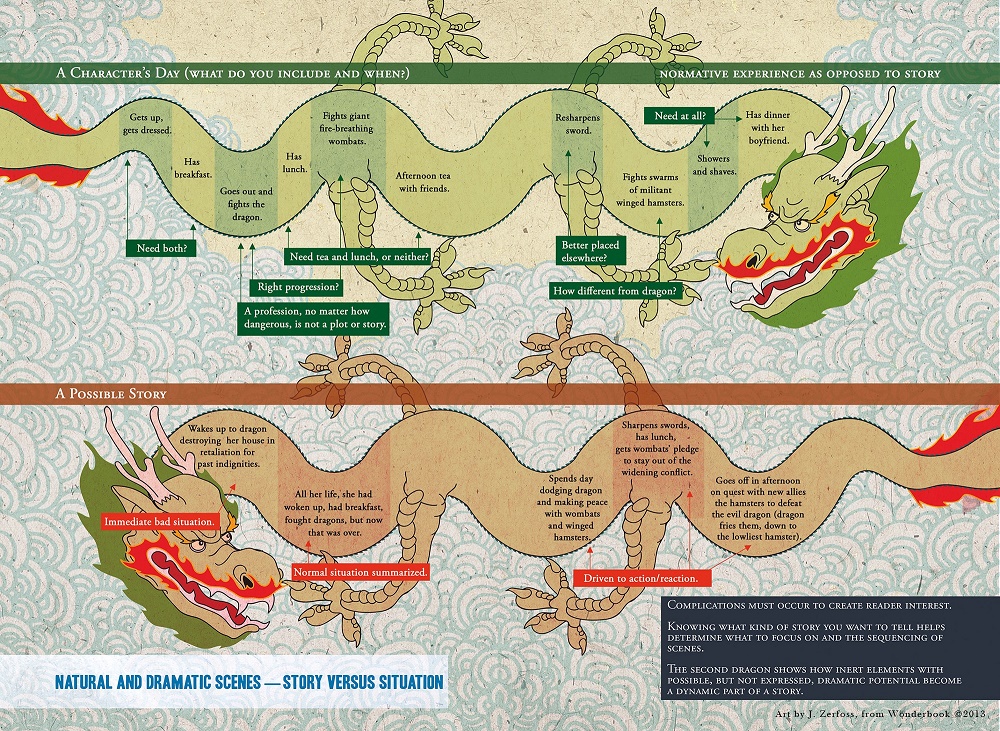
Jeff Vandermeer's Wonderbook is one of the most beautiful I have seen.  Now I need to read it.  He has given lectures on the same content using images found in the book.  Find it here.  The image below, from the link and the book, has been shrunk. Click on it to a somewhat larger size or follow the second link to see it full-size.

---
'Verbing' is annoying for some people.
If you’ve ever been in a conversation with someone who makes liberal use of the verb form of summer – which is, coincidentally, also its nominal form – you’ve probably rolled your eyes at such egregious snobbery. Unless, of course, you were simply waiting your turn to share about your own summering, in which case it is probably correct to assume you also enjoy yachting, golfing, and cardiganing.
and
Indeed, in 2007, when Mike Huckabee was a candidate for the Republican nomination for US president, he used it on the campaign trail to differentiate himself from his Ivy League rivals: “For my family, summer was never a verb. We never summered anywhere.”
Well, plenty of other people have summered – for more than 500 years. According to Trish Steward, assistant editor at the Oxford English Dictionary, the verbal use of summer “goes back quite a long way,” its first recorded use being 1440.
I believe this is described as fossilization of a language.  The words and forms you heard as a child will always the the 'right' ones.   Verbing doesn't bother me that I can recall. As a competitive swimmer, the verb 'medalling' was common enough that it never upset me.

Other examples that affect me are Gonna, Wanna, and Hafta, but the one that really grates on my ears and seems common in the UK is "Haven't got". It's "Don't have", for crying out loud!
---
Twenty-eight thousand words in a single flight.
The article is difficult to summarize but here are his main points.
  • Sleep during take off.
  • Laptop on lap rather than chair table.
  • Headphones, Ommwriter, Flux and background music
  • drink a lot (of water) and don't eat.
  • Get up every three thousand words
  • Do exercises (ten pushups or squats) in the galley areas a few times
  • Save frequently.

The author travels business class and can plug in his computer so he has power for the whole flight. I love Ommwriter (the Mac version is better) and Flux apparently resets the lighting so your eyes don't ache in low light situations.
---
The latest Hugo Awards shenanigans.
Question: If you could pick a single writer to make an effective, compassionate statement about identity politics to a divided literary community, who would you pick? Would it be a schizophrenic, autistic person who’d authored an e-book called Space Raptor Butt Invasion?
For years, writers and fans of science fiction and fantasy have been confronting that first question. And inadvertently, at the behest of right-wing trolls, the answer to the second question has recently become yes.
Via.
---
I know things that I didn't even know I knew.
---
Will I make money as an artist?
---
Lessons for Story Tellers at the World Domination Summit

(2) You can always edit more than you think
What it is the point we’re trying to get across with this story?
And then,
What can I cut out, but still get this point across?
It’s brutal. But in the end, I managed to edit some stories down to 30 seconds – which gave us wiggle room to add some details back in

---
Spoon! Jimmy Diresta makes one.


Boingboing has a quote from him with a link that didn't work for me.

As a dabbler who hasn't done enough continuously enough to learn by doing, videos like these are wonderful.  At the beginning, Diresta makes his block on two sides with the rough shape of his spoon.  Of course, once he cuts on axis, the marks have been removed. What does Diresta?  He applies glue to the part that will be next cut off and rebuilds his block. Then he cuts again and the rough is cut free top and bottom, left and right.  That was worth the price of the video right there.

And a graphic reminder:
This image was many places. I found this one on Reddit.
---
Pelee Island Writer's retreat funding on Indiegogo.
The funds raised in this one-time effort will be used for the start-up costs for the Pelee Island Book House and Writers' Retreat. Known for its beaches and birding, the island's quiet beauty makes it an ideal location. Perks are offered at every level,
---
Work free, for exposure.
I, uh, am attempting to write a (very) short story for this blog every week - see 'click bait' for stories - to produce content for this blog to attract eyeballs and good feeling from readers so that when I publish a book,there'll be some people to read it.  Maybe even pay for the dubious pleasure of reading it.  These stories are free - and that is probably a realistic measure of their value - and i do it for exposure.
Of course, I am doing this by choice, on my own platform.
At For Exposure, there is a long list of screen caps showing people asking for artists to work for free and getting angry when the artist asks for money. The above link is to a Twitter account and I think the examples are collected here on Imgur. As always, I have shrunk the images. To see them fullsize, and many, many more, follow the link.


Ha. Vulva owners!
--
And more on the same subject. Vice allegedly treats its freelancers badly.
IN AN ERA OF JOURNALISM in which freelancers have grown accustomed to being treated like disposable cogs of news production, Vice appears to be in a league of its own.
Interviews with more than a dozen freelance journalists suggest the young, edgy news organization heralded as the future of journalism also has ushered in a new low for its treatment of freelance journalists.
Via Boingboing.

Sunday, February 14, 2016

Home Town Author and other writing news

A local newspaper interviewed Midland, Ontario author, Wade Shatford.
Shatford writes in the genre of “dark fantasy,” in which grim and adult themes are incorporated into the traditionally child-oriented school of fantasy.
“I read fantasy a lot as a kid,” he said. “Dark fantasy is a platform for people who have grown up with this genre and take a literary twist on it.”
...
Self-publishing through Amazon has become popular for aspiring writers. Shatford said it is a simple process of uploading a manuscript to the site.
“There’s a million books up there and it’s up to you to generate interest,” he said. “And some people have really hit home runs with it.”
Shatford said he hopes his books will be among the home runs. He recently sold a copy in England.
“Go, Internet, go,” he said. “With the press of a button, worldwide exposure.
His Amazon page.  From the Goodreads page for one of his books:
I set out to write `Heart of Darkness' with a dragon and an anti-hero set on revenge. Metaphorically, the book is about weapon proliferation in both society and internationally.
I have downloaded the Amazon sample for the book and will update this post after I have read it.
Added Later: I finished the sample. I went in expecting poor formatting or spelling but the book feels professionally edited and I have no complaints.  The story, too, was clear and I read the sample quickly. In the part I read - no spoilers because it was only the sample - the man who eventually became a monstrous king started as a boy who went through terrible privations and hardship, losing more and more of his family and learning to kill before he was ten.  It felt a lot like Con Iggulden's series about the rise of Ghengis Khan, although the hardships that worthy faced were somewhat based in reality.
It was all well-done but not my type.  If you like Iggulden's books for more than the historical aspects, this book might be for you.  I wish I could get over the sub-genre or whatever my problem is because I think it is well-written, again, just not my type.
----
It is time to apply for the M Literacy residencies in China and India in 2017 if you are interested.
---
Apparently, People of Colour destroy Science Fiction - new kids with their hip lingo; it seem this is positive.
---
Darwin Day was a few days ago.  Scientific American has a book out describing the minds of histories great personalities and describes Darwin as a worrier.  On this blog, I have looked at the uncertain link between mental illness and creativity and also at studies which show the early loss of a parent is a common factor among histories geniuses. An excerpt from the book:
Studies have shown that the loss of a parent in early childhood can significantly increase the risk of both depression and anxiety later in life. And Darwin was profoundly affected by the way his mother died—quickly and inexplicably—according to Janet Browne, author of a highly acclaimed two-volume biography of Darwin. Darwin worried incessantly that he or his children had inherited a weak constitution from his mother’s side of the family, and he knew from her experience that sickness could quickly turn deadly.

Saturday, September 27, 2014

Twine and CBC short story contest

Twine is, well, I'm still figuring it out myself, but it seems to be a way to make interactive fictions and at least text-based games similar to the old choose-your-own-adventure books of my childhood.  It seems pretty cool and I will be playing with it further.  What I've seen is pretty cool.  Twine 2.0 is now in beta, which I think means it is mostly ready to use. More info from the maker. Wikipedia has a stub on the subject.
Ah, Gamespot has more:
It allows you to link passages of text via links, which has led many people to compare games made with Twine to old Choose Your Own Adventure books. But Twine allows you to do things that those books never could. Games can keep track of decisions made and actions taken by players much earlier in the game--what type of weapon they selected, for instance, or whether or not they collected a particular key. With a bit of creativity on the part of the creator, games can have puzzles that players can't quickly "solve" by just trying each of a few options. Games can also include images and videos, and with a bit of extra know-how, you can also employ basic effects, such as flashing text, which can do a good deal to foster a particular mood in your game.
---
The CBC's short story contest, Canada Writes, is running now.  They are accepting stories of between 1200 and 1500 words until November 1.  Entry is limited to Canadians or residents of Canada and there is a $25 fee to enter the contest.  The CBC also has a word cloud of clickable tips for writing.

Tuesday, May 13, 2014

TWIC (Mid May Edition)

From the Hanoi grapevine:
M Literary Residency 2015-2016 in Shanghai/Bangalore: call for applications
Deadline of applications: 20 Jun 2014
Residency duration: from late 2015 to early 2016 (10-12 weeks)
From the open call:The M Literary Residency Programme, fully funded by M Restaurants, grew from our Literary Festivals, as we heard from writers about what was needed to nurture and produce the best writing in this region.
Applicants may apply for ONE of two M Literary Residencies:Bangalore, India: A 10-12 week residency at Sangam House, in a rural setting near Bangalore, South India from late 2015 to early 2016. (Please note: Residency dates are set by Sangam House.)
Shanghai, China: 10-12 week residency in Shanghai. The residency must be taken up before March 1st, 2016, and be completed in one continuous period.
EligibilityThe residencies are open to all writers of fiction, nonfiction, poetry, and dramatic prose. There are no nationality restrictions, however, applicants should be over 21 years old at the time of application and be writing in English. Unpublished authors and past applicants are also eligible.
FundingThe successful applicants will have transportation costs to and from the residencies covered by the M Residency and a total stipend of US$1,000 to cover additional living costs during their stay. Applicants are responsible for their travel/medical insurance and visas.
----
I just finished an online class titled "Creativity: Music to my ears" - You can guess why I signed up.  The main project was to choose a problem and think of a hundred (or more) ways to solve.  My group looked at using music to encourage people to read.  Completely independent of our work comes this news from Scientific American. Most of the article is gated; Here is an excerpt:
 Today a symphony of research trumpets the many links among language, reading and music, including several that reveal a connection between rhythm and reading skills.
----
12 principles of animation:
As action starts, we have more drawings near the starting pose, one or two in the middle, and more drawings near the next pose. Fewer drawings make the action faster and more drawings make the action slower. Slow-ins and slow-outs soften the action, making it more life-like. For a gag action, we may omit some slow-out or slow-ins for shock appeal or the surprise element. This will give more snap to the scene.
----
Inequality and the arts
There’s a reason why a lot of modern culture was produced by people living on a shoestring, from the New York intellectuals to all those poets and painters starving in their fabled garrets. It’s time-consuming to do something original; it requires bad manners, or at least a lack of automatic deference for received wisdom; and it helps to have an abundance of low-paid but undemanding jobs around–mailman, night watchman, librarian, clerical worker–that one can drift in and out of, as well as a few cheap urban neighborhoods where like-minded artistic riff-raff can congregate. (Russell Jacoby’s description, in The Last Intellectuals, of the ecology of the freelance intellectual has never been bettered.)
----
Science Fiction from South East Asia - including Korea which I didn't consider all that southerly.
----
The RIAA isn't doing much to help artists even as it squeezes companies, apparently to collect royalties for them.
----

A writer on writing. An acquaintance, Gord Sellar, doesn't really care for the device of making the main character of a story a writer.  I guess he thinks it is a kind of a cheat.  I do recall several books by Stephen King that featured writers.  Still, he (back to Mr Sellar) likes this bit by Paul Auster:
There were other decisions to be made, of course, a host of significant details that still had to be conjured up  and worked into the scene–for purposes of fullness and authenticity, for narrative ballast. How long has Rosa been living in New York? for example. What does she do there? Does she have a job and, if so, is the job important to her or simply a means of generating enough money to cover the rent? What about the status of her love life? Is she single or married, attached or unattached, on the prowl or patiently waiting for the right person to come along? My first impulse was to make her a photographer, or perhaps an assistant film editor–work that was connected to images, not words, just as Grace’s job was. Definitely unmarried, definitely never married, but perhaps involved with someone, or, even better, perhaps recently broken up after a long, tortured affair.
Giving characters a backstory that might not appear necessary appears to be an important part of writing believeable characters.
--------------
Storium - turning writing into a multiplayer game:
With just your computer, tablet, or smartphone, you can choose from a library of imaginary worlds to play in, or build your own. You create your story's characters and decide what happens to them. You can tell any kind of story with Storium. The only limit is your imagination.
Storium uses familiar game concepts inspired by card games, role-playing games, video games, and more. In each Storium game, one player is the narrator, and everyone else takes on the role of a character in the story. The narrator creates dramatic challenges for the other players to overcome. In doing so, they move the story forward in a new direction. Everyone gets their turn at telling the story."
Storium offers worlds to play in created by authors, transmedia writers, and game designers, and one of the perks of supporting the Kickstarter campaign is instant access to the already-running beta.
----
Advice from on beating writer's block Ask TON, One excerpt:
Rose Eveleth, freelance writer and producer and BBC Future columnist:I have a tiered strategy for dealing with writer’s block. The first tier is prevention (is it cheating to include that?) which means that before I write, I make sure that I’m ready to write. That sounds obvious, but I’ve found that the easiest way for me to get stuck on something is for me to not be fully mentally prepared to put words to page (er, screen, or whatever). I put on my writing music (usually this Songza playlist) close all my social media distractions, and set a goal for myself. Sometimes that’s “write an outline of this story” or maybe it’s “just vomit everything out so we can fix it later,” but whatever it is, I find that having a goal that’s more specific than just “write” is really helpful to make sure that I actually do write something.
----
What is good writing?  Quora took a shot at answering the question.
Anne Zahra tells us, "Good writing is writing that makes you forget you are reading.

If you can make me forget that I'm sitting in my rocking chair and tracing your train of thought across a page or a screen, it's because you know what you're doing."I gotta agree.Many e-books are poorly edited and tripping over a misspelled word knocks me back into my seat and out of the story.

Dinesh Dharme offers a list of 9 points.  Here is part of four:
3. Good writing is like good teaching. Good writing strives to explain, to make things a little bit clearer, to make sense of our world… even if it’s just a product description.“A writer always tries… to be part of the solution, to understand a little about life and to pass this on,” says Anne Lamott in Bird by Bird.
4. Good writing tells a full story.  Good writing roots out opposing viewpoints. AsJoe Chernov says, “There’s a name for something with a single point of view: It’s called a press release.” Incorporate multiple perspectives when the issue lends itself to that. At the very least, don’t ignore the fact that other points of view might exist; to do so makes your reader not trust you.So make sure he or she knows you’re watching out for them. To quoteHemingway: “The most essential gift for a good writer is a built-in, shockproof, shit detector.”
5. Good writing comes on the rewrite. That implies that there is a rewrite, of course. And there should be.Writing is hard work, and producing a shitty first draft is often depressing. But the important thing is to get something down to start chipping into something that resembles a coherent narrative.As Don Murray said, “The draft needs fixing, but first it needs writing.” Or Mark Twain: “Writing is easy. All you have to do is cross out the wrong words.”
6. Good writing is like math. I mean this in two ways: First, good writing has logic and structure. It feels solid to the reader: The writer is in control and has taken on the heavy burden of shaping a lumpy jumble of thoughts into something clear and accessible.It might not follow a formula, exactly. But there’s a kind of architecture to it. Good writing has more logic to it than you might think.Second, good writing is inherently teachable—just as trigonometry or algebra or balancing a balance sheet is a skill any of us can master. Journalism professorMatt Waite writes in his essay, How I Faced My Fears and Learned to Be Good at Math: “The difference between good at math and bad at math is hard work. It’s trying. It’s trying hard. It’s trying harder than you’ve ever tried before. That’s it.”

.----
Not entirely on topic, but I liked this breakdown of Jesus' abilities as a charismatic leader.
(3) Jesus always does something unexpected
On a Sabbath Jesus was teaching in a synagogue, and a women was there who was crippled for 18 years, bent over and unable to straighten up. Jesus called her forward and said to her, “Woman, you are set free from your infirmity.” Then he put his hands on her, and immediately she straightened up and praised God.Indignant that Jesus had healed on the Sabbath, the synagogue leader said to the people, “There are six days for work. So come and be healed on those days, not of the Sabbath.”  Jesus answered him, “You hypocrites! Doesn’t each of you on the Sabbath untie your ox or donkey from the stall and lead it out to give it water? Then should not this woman, a daughter of Abraham... be set free on the Sabbath from what bound her?” When he said this, all his opponents were humiliated, but the people were delighted.  (Luke 13: 10-17.  Similar conflicts about healing on the Sabbath are in Luke 6: 6-11; Matthew 12: 1-14; and Luke 14: 1-6, which ends by silencing the opposition.)