Showing posts with label words. Show all posts

Wednesday, November 7, 2018

Nanowrimo, learning about 'pimping' from Google Spellcheck

"Limped" is a word, right? Past tense of "to limp", right?

Google Spellcheck highlighted it and suggested I meant 'pimped'. It that so common a word? Am I so old?


"Alphaadeul' is the name of a character in my story. I needed a fantasy name and folded Greek and Korean together. Then I found I couldn't really do that for the entire story. I can't have 30% of my characters have the same name. Not unless my story is about the nature of identity.

Anyway, I guess a lot of people are pimping.

Sunday, September 4, 2016

TWIC: Grants, Writers and writing, Spoon, Pelee Island Retreat, pay

On Quora, the question How do you write a good grant proposal was asked and answered.
The answer (so far there is only one) is to find examples in books or in a Google search.  Most such proposals are generally vague and dry so adding some detail and working to make them interesting is important to be noticed.
--
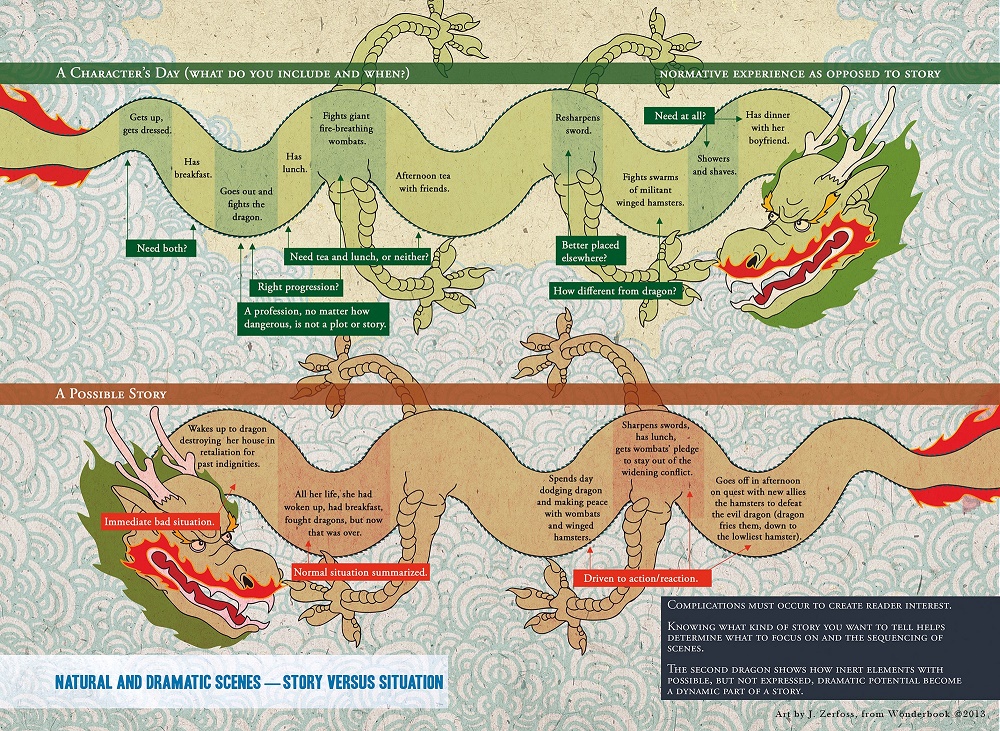
Jeff Vandermeer's Wonderbook is one of the most beautiful I have seen.  Now I need to read it.  He has given lectures on the same content using images found in the book.  Find it here.  The image below, from the link and the book, has been shrunk. Click on it to a somewhat larger size or follow the second link to see it full-size.

---
'Verbing' is annoying for some people.
If you’ve ever been in a conversation with someone who makes liberal use of the verb form of summer – which is, coincidentally, also its nominal form – you’ve probably rolled your eyes at such egregious snobbery. Unless, of course, you were simply waiting your turn to share about your own summering, in which case it is probably correct to assume you also enjoy yachting, golfing, and cardiganing.
and
Indeed, in 2007, when Mike Huckabee was a candidate for the Republican nomination for US president, he used it on the campaign trail to differentiate himself from his Ivy League rivals: “For my family, summer was never a verb. We never summered anywhere.”
Well, plenty of other people have summered – for more than 500 years. According to Trish Steward, assistant editor at the Oxford English Dictionary, the verbal use of summer “goes back quite a long way,” its first recorded use being 1440.
I believe this is described as fossilization of a language.  The words and forms you heard as a child will always the the 'right' ones.   Verbing doesn't bother me that I can recall. As a competitive swimmer, the verb 'medalling' was common enough that it never upset me.

Other examples that affect me are Gonna, Wanna, and Hafta, but the one that really grates on my ears and seems common in the UK is "Haven't got". It's "Don't have", for crying out loud!
---
Twenty-eight thousand words in a single flight.
The article is difficult to summarize but here are his main points.
  • Sleep during take off.
  • Laptop on lap rather than chair table.
  • Headphones, Ommwriter, Flux and background music
  • drink a lot (of water) and don't eat.
  • Get up every three thousand words
  • Do exercises (ten pushups or squats) in the galley areas a few times
  • Save frequently.

The author travels business class and can plug in his computer so he has power for the whole flight. I love Ommwriter (the Mac version is better) and Flux apparently resets the lighting so your eyes don't ache in low light situations.
---
The latest Hugo Awards shenanigans.
Question: If you could pick a single writer to make an effective, compassionate statement about identity politics to a divided literary community, who would you pick? Would it be a schizophrenic, autistic person who’d authored an e-book called Space Raptor Butt Invasion?
For years, writers and fans of science fiction and fantasy have been confronting that first question. And inadvertently, at the behest of right-wing trolls, the answer to the second question has recently become yes.
Via.
---
I know things that I didn't even know I knew.
---
Will I make money as an artist?
---
Lessons for Story Tellers at the World Domination Summit

(2) You can always edit more than you think
What it is the point we’re trying to get across with this story?
And then,
What can I cut out, but still get this point across?
It’s brutal. But in the end, I managed to edit some stories down to 30 seconds – which gave us wiggle room to add some details back in

---
Spoon! Jimmy Diresta makes one.


Boingboing has a quote from him with a link that didn't work for me.

As a dabbler who hasn't done enough continuously enough to learn by doing, videos like these are wonderful.  At the beginning, Diresta makes his block on two sides with the rough shape of his spoon.  Of course, once he cuts on axis, the marks have been removed. What does Diresta?  He applies glue to the part that will be next cut off and rebuilds his block. Then he cuts again and the rough is cut free top and bottom, left and right.  That was worth the price of the video right there.

And a graphic reminder:
This image was many places. I found this one on Reddit.
---
Pelee Island Writer's retreat funding on Indiegogo.
The funds raised in this one-time effort will be used for the start-up costs for the Pelee Island Book House and Writers' Retreat. Known for its beaches and birding, the island's quiet beauty makes it an ideal location. Perks are offered at every level,
---
Work free, for exposure.
I, uh, am attempting to write a (very) short story for this blog every week - see 'click bait' for stories - to produce content for this blog to attract eyeballs and good feeling from readers so that when I publish a book,there'll be some people to read it.  Maybe even pay for the dubious pleasure of reading it.  These stories are free - and that is probably a realistic measure of their value - and i do it for exposure.
Of course, I am doing this by choice, on my own platform.
At For Exposure, there is a long list of screen caps showing people asking for artists to work for free and getting angry when the artist asks for money. The above link is to a Twitter account and I think the examples are collected here on Imgur. As always, I have shrunk the images. To see them fullsize, and many, many more, follow the link.


Ha. Vulva owners!
--
And more on the same subject. Vice allegedly treats its freelancers badly.
IN AN ERA OF JOURNALISM in which freelancers have grown accustomed to being treated like disposable cogs of news production, Vice appears to be in a league of its own.
Interviews with more than a dozen freelance journalists suggest the young, edgy news organization heralded as the future of journalism also has ushered in a new low for its treatment of freelance journalists.
Via Boingboing.

Tuesday, April 19, 2016

I want to be obsessed

A lot of psychology is biology and I know a fair bit in that field.  One course I took, Animal behavior, was  a strong introduction to the subject.  In this post, I will write about what I think of as obsession. I think I follow the basic definition Google offered at the top of its search window:
an idea or thought that continually preoccupies or intrudes on a person's mind.
plural noun: obsessions
"he was in the grip of an obsession he was powerless to resist"
synonyms: fixation, ruling/consuming passion, passion, mania, idée fixe, compulsion, preoccupation, infatuation, addiction, fetish, craze, hobbyhorse;
but I want it clear I make no claim to the psychological definition of the word and that I find the casual use of 'OCD' to be annoying.

I recently wrote to a friend about our obsessions.  He put himself on a strict diet for two weeks to see what would happen and one result was he dreamed and lusted for the wondrous food he would eat after the two weeks had passed.  In 2015, I gave myself the goal of running 183 times in the year. I, uh, like talking about the thing I was obsessed with; that can't be a surprise, but it really isn't a subject relevant to this blog.  I'm still going to write about it, but I posted it in the 'read more' or 'under the fold' area.  If you want, you can find it there.

The point of the longish story below is that I set goals and stuck to them pretty well, even though I didn't really enjoy them. Or I enjoyed them but also found them exhausting and irritating.  My friend, struggled through his labour and doubtless enjoyed seeing his weight drop and feeling physically better even though it presented a physical struggle.

I have a blog post from Asana open. It is called Working from home? Here’s how to stay on task.  I really should read it. I'm good at finding such articles, and I read many of them.  Reading is good.
It would be much freakin' better if I convinced myself to follow such articles!

In the eighties and early nineties, I watched Prisoner of Gravity, as TVO show about science fiction and fantasy books and movies. In season four and five, there were episodes with advice for writers.  One point I remember from those episodes was the advice, 'If you can find something else to do, then do that instead'.  You needed to be obsessive and driven to write for it to work.

I have a job.  I'm an ESL teacher and I work to make the subject interesting to my students, many of whom are there chiefly because they have to be.  I have large periods of time off and I always plan to revamp my teaching and try new ways.  And I do, I still think I am a good teacher, but not nearly as much as I could.

I started this blog to document my research into creativity and to understand how to do and how to teach it.  I definitely know enough that I should be a creative person now. And when I have a problem, I use creative methods to find a solution. But I am not producing much, if any, more than I did when I began at Creativiti Project.

So, here are more than fifteen hundred words about writing that aren't directed at the story I have been trying to write for the past few months. It seems that I need to trick myself to write.

I am creative.  I need to be obsessive.

I love Grant Snider's comics and this one seems a relevant.  I have shrunk it here, follow the link for the full size version or ways to buy it. I added the red circle:
I either need no other work or I need other work I want to avoid.  Actually, I would probably avoid both.


Tuesday, January 26, 2016

TWIC: Reading, wRiting and Rworking

If there is a theme in today's This Week in Creativity, the title captures it.  Oh, also a travel musing.

The International Teacher Development Institute has a class on creative writing - or two classes that you  can take together.  The themes are poetry and prose.
In The ELT Creative Writers' Retreat, short poems will lead us into the writing of personal memoir as we work together to develop as writers and explore the depths of our lives while learning how to use a Writer's Workshop Approach in our English classes. In Poetry in ELT we'll explore the many ways poetry can be used in the English Language Classroom.
The fee is US$89 for one and US$125 for both.
---
Dave Moldawer at Boingboing tells us what publishers should do.
For me, this is what publishers should do, whether they are publishing books, websites, conferences, or, well, operating systems: “Look at this. I'll put a frame around it, because the creator cannot truly frame the work. Here is what you need to know to appreciate this. Here is how you should think about this. Consider.”
A good publisher is that amazing, life-changing professor from sophomore year at scale.
The need for this work—publishing—is more desperate than ever, and most book publishers don’t even bother to pay lip service to this essential role of their business.
---
Typing slowly (or hand writing) results in better, uh, writing.  It's weird when writing refers to the motion of your hand and to the content.
“Typing can be too fluent or too fast, and can actually impair the writing process,” Srdan Medimorec, a PhD candidate in the Faculty of Arts at Waterloo said in a statement. “It seems that what we write is a product of the interactions between our thoughts and the tools we use to express them.”
The study, which was published in the British Journal of Psychology, asked some participants to type essays with both hands and others to type with one. According to Medimorec's team, participants who used one hand took more time to come up with words and even used a larger vocabulary. People who typed fast, the study notes, probably went with the first word that came to mind.
---
How do novelists and writers get inspired?  A question with a variety of answers at Quora. Jeremy Scheurer wrote:
One thing that stuck out to me, was that many authors and novelists had a common trait. Many of them have a small book, a legal pad, a practical app or something like that where they write down anything important to THEM, that happens in their life. 'Overhearing an interesting conversation in the train'. 'Meeting somebody exceptional'. 'Having felt a special feeling in a specific situation'. 'Seeing somebody with a unique appearance'. All this little things get written down. This way they will be able to feel back to that specific situation and they won't forget about important or subtil things that might inspire them for more.
---
I was a beta reader in Dec 2015 for the first time and wasn't sure what was expected of me.  On the NaNoWriMo blog, the general details are described although I would have liked more examples.  In my case, I pointed out a few big-picture questions - in this fantasy world, families and death didn't mean the same things they mean here but the differences were not clear enough for me. I also noted several adverbs I found strange. The author thanked me and I hope to hear further in a few months. Note to self: contact that author in March to see how the book is progressing.

---
Outline your novel in eleven 'easy' steps I put 'easy' in quotes because the steps are fairly detailed. They might be easy but are also meaty.
Constructing a Timeline
1.1 Technique: Write a List
1.2 Technique: Map the Events on a Line
1.3 Technique: Master the Mind-Map
2 Explore Your Character Arcs
3 Establish Your Settings
4 Choose the Shape and Style of Narration
5 Assess Your Plot-in-Progress
6 Identify the Core Message
7 Segment Your Outline Into Chapters
8 Essential Components of Your Story's Beginning
8.1 Character
8.2 Setting
8.3 Plot
8.4 First Chapter
9 Essential Components Of Your Story's Middle
9.1 Midpoint
9.2 The Black Moment and Plot Point 2
10 Essential Components of Your Story's End
10.1 Climax
10.2 Final Chapter
11 Reassess and Reorder Your Scenes
11.1 ***
---
How to read a scientific paper.
---
A friend and fellow competitive swimmer back in the 80's now has a work-coaching company and she was recently interviewed on How to Create a More Focused Workplace. Perhaps being a swimmer and so a slave to the second hand of a clock has made her acutely aware of the passage of time because her suggestions mostly focus on the subject.
----
Ten Habits of Highly Creative People.  I've covered the subject often and it dates back at least to Cziksentmihalyi (I can't be the first guy to misspell his name).  I think that I need to reread these points though and particularly work on #6: Openness to Experience.
Research has found that the desire to learn and discover seems to have significantly more bearing on the quality of creative work than intellect alone. So, if you want to boost your creativity, try out a new creative outlet or a totally different medium of expression, or take a new route home from work, or seek out a new group of people with different interests or values that you might learn from. Openness to new experiences can help increase your integrative complexity—the capacity to recognize new patterns and find links among seemingly unrelated pieces of information.
---
Back to the teaching theme: Seven Ways to help High Schoolers Find Purpose.

As an ESL teacher who simply needs students to talk, here is the area I focus on most:
Foster collaboration
Consider how different high school would feel if students were working in collaboration with their peers instead of competing against them all the time? What if high school grading was based on how well you worked with other people and how well you mentored and advised your peers? This would much more accurately mimic most workplaces, where teamwork and collaboration are some of themain skills desired by today’s employers.
--------
As a bit of motivation, remember that hobbies make us happier.  Go ahead and carve that chunk of wood or scribble endlessly at that story.
---
Finally, I did a bit of flying last week and, as always, noted the huge variety of vehicles on display at airports.  Airports are where creativity in purely land vehicles has raged wild.

Image from geminijets.

Friday, November 13, 2015

Words typed but not spoken

At Poynter, there is a crowd-sourced list of words people, especially journalists, use in print but that people seldom say. Here are the top five, follow the link for more.

  • Lambaste
  • Foray
  • Ballyhoo
  • Tout
  • Oust
Here in Korea, I see the word 'mull' in the English newspapers frequently.  I have seen it in Canadian writings but not as often as here.  I have used the word, but only literally -as in mulling wine - or ironically because the frequency rate is so skewed.  Few people get that sarcasm - it's an in-joke for one.